BOOK 1 OF A 3-BOOK SET ON THE UTILITY GRID POWER SYSTEM
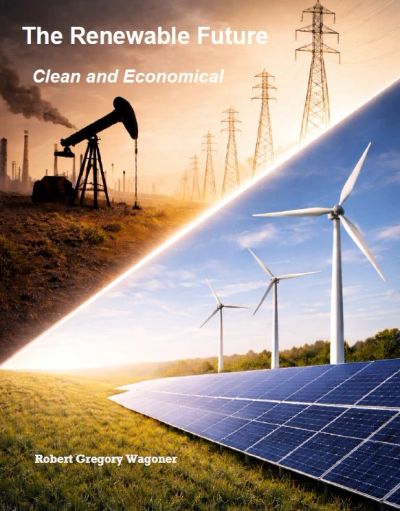
The Renewable Future - Clean and Economical
Renewable electricity is not made by press release. It is made by machines that obey the same physics as everything else we build, and this book is about those machines.
It opens with the case for change: fossil fuels are a one-time inheritance that grows harder and costlier to extract, while sunlight, wind, water, and the Earth's heat arrive new every day. Then it turns to the hardware. You will see how solar, wind, hydropower, geothermal, and nuclear plants turn a resource into power a grid will accept, why manufactured technologies like solar and wind keep getting cheaper, and where each one reaches its limits. It goes where many books stop: how a turbine survives twenty years in the field, how a resource becomes a bankable estimate, and why a gigawatt of one technology is not a gigawatt of another.
The book is written in layers. The chapters use plain language and no mathematics, and each closes with key takeaways and a short brief for decision-makers. Behind them sit 25 appendices that range from accessible surveys to graduate-level engineering: the Betz limit and blade aerodynamics, turbine control and safety systems, structural fatigue, photovoltaic device physics, power electronics, and design for reliability. Reading tracks point the decision-maker, the student, the field technician, and the practicing engineer to the pages that serve them.
It is the first piece of the story: making the power.
BOOK 2 OF A 3-BOOK SET ON THE UTILITY GRID POWER SYSTEM

Grid at the Edge
Generating clean power is only the start. On April 28, 2025, Spain and Portugal went dark in about ninety seconds, and fifty-five million people lost power. The grid had plenty of generation that morning. What it lacked was control, and that distinction is the thread of this book.
It explains how a continent-scale grid holds its balance every second, and what changes when variable wind and solar replace the spinning machines the system was built around. It covers the duck curve, intermittency, demand response, and storage, including why batteries alone cannot carry a season. It examines how grids fail, from Texas in 2021 to South Australia in 2016, and takes on the constraints that decide what can scale: land, materials, supply chains, transmission, and security against attack.
Every chapter opens with a case study in plain language and closes with key takeaways and a brief for decision-makers. Newcomers get accessible surveys of storage and grid control. Engineers get worked treatments of frequency dynamics and inertia, power flow and fault calculation, grid-forming inverter control, and protection of inverter-dominated systems. A casebook dissects more than two dozen grid events, from the 1965 Northeast blackout to 2025.
For engineers who want the system-level view that specialized training leaves out, and for policymakers, investors, and students who need to judge which solutions will scale.
BOOK 3 OF A 3-BOOK SET ON THE UTILITY GRID POWER SYSTEM
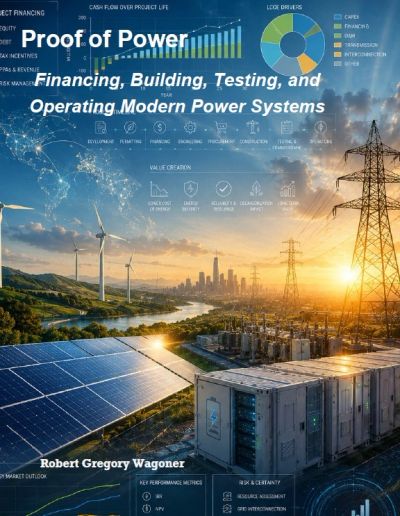
Proof of Power
A power plant that works is not the same as a power plant that pays, lasts, and delivers. In 2023, the world's leading offshore wind developer wrote off about four billion dollars on projects whose turbines, engineering, and wind resource were all sound. What failed was everything else, and everything else is the subject of this book.
It follows a project through its whole life: what the cost of energy captures and leaves out, why cheap power at the plant can arrive expensive at the meter, how financing and contracts decide what gets built, and how interconnection queues and permitting slow it down. It continues through testing, commissioning, and grid-code compliance, then into decades of operation: wind and solar failure modes, battery degradation, and the fleet-wide defect that turns one bad part into a costly campaign. It closes with candid assessments of hydrogen, carbon capture, and emerging technologies, and a grounded estimate of how long the transition will take.
The chapters read in plain language, with optional boxes for readers who want the math. One-page tools give practitioners working checklists for interconnection, commissioning, and procurement. Graduate-level appendices cover financial modeling, reliability engineering, and electrical safety, and a nine-question checklist lets anyone test an energy claim. Reading tracks serve the engineer, the investor, the student, the field technician, and the homeowner.
For those who build these plants, fund them, or run them, it answers the question the whole set leads up to: does it hold up, and does it pay?